

Barracuda in the Attic: Kipp Friedman Q&A
My favorite bookstore in the Chicago area was always Bookman’s Alley, a coiling space tucked into an Evanston alley, in the shadow of Northwestern University. It resembled a sleepy intellectual’s living room—the Strand, as if run by WASPs. For years, the store seemed on the brink of closing (and now appears to be shuttered) and whenever I was in town to visit my parents I would stop in, sniffing out bargains. At some point, for reasons unknown, I fell into a routine of buying books by Bruce Jay Friedman while in Bookman’s Alley. This can happen—you buy your Randy Newman LPs at this record shop, David Bowie albums at that one—and over time, I suspect the proprietor took note.
“You know, Bruce Jay Friedman’s son came to the store for an event for his own book,” he told me.
“Ah, yes—Drew Friedman,” I said, speaking of the illustrator. “His work is mind-blowing. Howard Stern claims he is better than Picasso.”
“No,” the store owner said, “Josh Alan Friedman, the writer and musician. He’s great.” Indeed, I had the wrong Friedman.
A few months later, I was in Chicago once more and returned to the store for another Bruce Jay Friedman. “You know,” the clerk said, “we have some books by his son.”
“Of course,” I said, now wise to the man. “Josh Alan Friedman.”
“No,” the clerk told me. “Drew Friedman—the illustrator.”
“Hmph,” I muttered. “Talented family.”
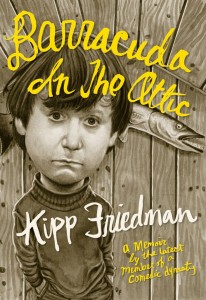
Complicating matters further, we now get Barracuda in the Attic (Fantagraphics), a charmed memoir about growing up the son of Friedman. And this book is by Kipp Friedman—the youngest of the three brothers. The book features a cover illustration by Drew Friedman, a foreword by Bruce Jay Friedman, and an afterword by Josh Alan Friedman. The author has a light, graceful touch. This is not a memoir to settle scores or search an author’s soul—Kipp Friedman writes as much about his older brothers as he does about himself. Many of its best patches depict the celebrity culture of 1970s New York and Hollywood, as witnessed through the eyes of a child or teen beamed into the world of his father. Often, the three brothers are seen as young hellions, at war with saner adult forces in Long Island and Manhattan. Pity the dupe who crosses paths with the trio.
Kipp Friedman, who lives in Milwaukee, will be in New York for readings at KGB Bar December 14 and 2A Bar December 16. In anticipation, the author answered a few questions about Barracuda in the Attic via e-mail:
This is your first book. What was its impetus? And its greatest hurdle?
Not surprisingly, it was my father’s idea that I start writing the stories that led to Barracuda in the Attic. Following my parent’s divorce in 1976, I moved in with my dad at his duplex apartment on East 63rd Street in Manhattan for the final year and a half of high school before attending the University of Wisconsin-Madison. This was a transitional period for my entire family, and my father has told me this was a particularly dark time for him as he adjusted to his new single life. We lived like two bachelors, surviving mainly on take-out pizza and watching Knicks games on TV. I also accompanied him on business trips, experiencing a number of adventures, and got to see first-hand the daily habits of an accomplished writer in mid-career. Most of all, it was a lot of fun hanging out with him because my father’s such a wonderful storyteller.
Years later, I was recalling how special that period was when he said it would make a great story. I told him I couldn’t wait to read what he would write, he being the famous writer in the family. But he said I should write it and I said I would, when I had some time. About 10 years later, as my 17-year-old son, Max, was preparing to leave for college, I started writing Life With Father (1977–78) all about that magical time I spent with my father. The story would eventually appear on a popular literary website in Manhattan and I would receive praise from friends and family. But I was most gratified when my father said he loved the story, even calling it “exceptional.” That, really, was all the impetus I needed to dig deeper and look back further into my childhood for more inspiration. The writing became addictive as I unlocked other buried memories from the past.
The greatest hurdle I faced was simply starting to write and trusting my instincts to make necessary changes and alterations along the way. I was a newspaper reporter earlier in my career and my journalism background was helpful in the writing of these stories. Each story in Barracuda in the Attic has a specific theme. The book does not follow a linear progression so there is no sequential order to the stories. The characters are mostly the same, but I shift back and forth in time, and remain faithful to the central theme of each story. For instance, I knew I wanted to write about my memories of my grandparents, who were very colorful personalities; my relationship with each of my brothers; my parents and their rocky relationship, which was sort of a sub-plot throughout our childhood; our youthful obsession with comic books; and even the impact monsters and horror movies had on us, all stemming from an incident when we went to see Night of the Living Dead when I was about seven (which, incidentally, is not the most appropriate viewing for a second grader!). I also knew I wanted to write about our trips out to Hollywood, starting in the late ’60s through the mid-’70s, accompanying my father while he was working on various TV show projects and movie scripts. New York City in the ’60s and ’70s also plays an important, recurring role throughout my stories.
The twin subjects of Barracuda in the Attic are probably family and fandom—whether for monster movies, sports, comedy, or comic books. Being a fan is a greater skill than people realize, and it seems that all three Friedman brothers are champions. Why?
I think there’s something in our family’s DNA that makes each of us gravitate toward the arts. As the youngest son of highly creative parents (my father being a writer and my mother a former actress, model, dancer and painter), I was literally swept along in my family’s enthusiasm for all things related to modern culture and the arts. My earliest memories are of being brought along to amusement parks, movie theaters, carnivals and circuses, parties attended by actors and musicians, art galleries, plays and musicals, watching endless hours of old movies and cartoons on TV, listening to records featuring Danny Kaye and Jerry Lewis, and more. Even visits to my grandparents’ apartment in the Bronx were madcap experiences filled with vaudevillian-like music, joke-telling, sight gags and more. Let’s face it—we were all basically a bunch of narcissistic Jewish hams clamoring for attention. Being the youngest with my big round eyes, I was quietly soaking it all in, which was very helpful in my recalling of our collective experiences.
When I was about three-years-old, I began sharing a room with my middle brother Drew, who was two years older than me. As a sort of welcoming gift, Drew had taped a life-size poster of Frankenstein’s monster, illustrated by Jack Davis, above my bed, which scared the hell out of me. Fortunately, our babysitter Mrs. Sullivan, a devout Catholic, had the good sense to name the monster “Percy,” and called it my guardian angel. Drew also had a “Frankie” monster statue on the floor facing my bed across the room. Drew had already begun to festoon his walls with pop culture drawings, ads and posters, as well as his own art work—a habit which would continue to expand as he grew older.
From the mid-’50s through about 1966, my father worked as an editor of men’s adventure magazines at the Magazine Management Company in midtown Manhattan and we would occasionally visit him there. His office shared space with Marvel Comics and my dad would hand us a stack of freshly printed Fantastic Fours, Amazing Spider-Mans and Dr. Strange’s. My dad’s cubicle was adjacent to Stan Lee’s.
At some point in the late ’60s, my father had discovered what we would affectionately call the “Back-Issue Store,” which was basically an old musty warehouse in a building in midtown Manhattan which stored old comic books and out-of-date magazines and other memorabilia. We were brought there every few months over a five-year period and usually got about a half hour to explore and purchase, on a budget, old comics, MAD and Famous Monsters magazines. My parents were also big foodies, so we were often taken along to try all sorts of exotic restaurants that were landing in New York such as Indian, Szechuan, Tex-Mex, and even Korean—long before they would become commonplace.
Did you use any advice from your father in writing the book?
My father was very encouraging throughout the writing process but he offered little actual advice, other than to keep writing. Occasionally he would make a suggestion on a word choice—something he has done all my life—and I recall him discouraging me at one point from using the tired metaphor of something collapsing “like a house of cards.” “You’re better than that,” he told me. But other than that he took a hands-off approach.
He has told me how proud he was of me just to write all these family stories and how much fun it was to have such a detail-rich record of our many family experiences. He said it also took a lot of courage to not only complete these stories, but to then get them published.
As I wrote in my story Life With Father (1977–78), I once asked him what he felt was the secret to good writing while I was working on a high school paper and he said two words: “specificity” and “authenticity.” At the time, I thought he could be a bit more descriptive, but he was right, and I thought often of those two words while writing Barracuda in the Attic.
My advice to aspiring writers is to have a general sense of what it is you want to say and then fill in the gaps. If someone can’t tell you what your story is about, you have two choices: say it’s an abstract work not meant to be fully comprehended and they have obviously missed the point; or, re-work the story so that even a foreign exchange student from Hyderabad, India can understand what’s going on.
The book is rife with brushes with colorful luminaries of the 1970s. With whom were you most excited to share air space?
Having dinner at Groucho Marx’s house in 1975 was the most surreal evening of my life. We had no idea what to expect. Groucho was 85-years-old and had suffered several strokes when we were invited by his somewhat controversial manager/girlfriend Erin Fleming, who told us that “Groucho loved kids.”
We knew we were in for an eventful evening the moment Groucho greeted us at the door of his home in the Hollywood Hills. He was dressed in a beret, a tropical shirt, a pair of boxer shorts that emphasized his bandy legs, and silver-metallic Apollo-astronaut-like slippers that were given to him as a gift from NASA. He must have sensed we were a bit nervous. “It’s a pleasure to meet you, Mr. Friedman,” he said in a weak voice. “You have three lovely daughters.” My brothers and I broke out into huge smiles as we each shook his hand.
Despite his advanced age, Groucho was surprisingly spry and energetic throughout the evening. He performed about eight or nine classic Marx Brothers songs following dinner, including “Hooray for Captain Spaulding,” “Hello, I Must Be Going,” and “Lydia, the Tattooed Lady.” Some have said that much of Groucho’s humor, especially on shows like You Bet Your Life, was scripted, but we saw first-hand his brilliant spontaneous humor, as he cracked one pun or amusing comment after another throughout the evening. Before we left, my father and Groucho exchanged books, each writing inscriptions to the other. When we got into the car, my father opened up his copy of Groucho’s memoir Groucho and Me and read aloud the inscription: “To Bruce. Nothing in this book will harm you. Groucho.”
Over the years, you have worked as a bar mitzvah photographer. Do you have a favorite war story to share? Any current bar mitzvah trends the Lowbrow Reader readership should be up on?
I have photographed about 300 bar and bat mitzvahs over the past 18 years, and after a while they all seem to blend into one. Fortunately, I do not suffer any post-traumatic effects—although I wince whenever I hear the song “Gangnam Style” and struggle with the Pavlovian impulse to break out into a horse-trot dance.
I wouldn’t say I have a “favorite” story but I do remember my first experience. I was standing on the ledge of a balcony of an old Milwaukee synagogue overlooking the stage during the bar mitzvah service. My camera was on a tripod and I was not allowed to shoot with flash so I had to use my zoom-length lens to capture the key moments with high-speed film—I know these technical details must sound fascinating—and I literally had only one chance to get the right shots. That’s when I heard a gravelly voice in the dark, demand: “Did you take pic-chas of the place-cahds!” I turned to find a troglodyte of a woman with a huge bouffant of hair supporting herself on a cane. She was the party planner, a legendary curmudgeon who was also known as a perfectionist. I asked her who she was and then I introduced myself and went on taking pictures. I knew she hated me from then on, but I got the right pictures and then quietly shot the table place cards before the guests entered the banquet hall following the service.
I don’t see any current trends in bar and bat mitzvahs other than that more people are scaling back their parties due to the economic downturn. Whenever asked, I suggest ways families can economize—from affordable DJs to alternative party venues—but remind them that their pictures are priceless and forever. Hey, a little guilt never hurts.